
When I was a club president, our membership list included a child whose parents nobody knew. The phone number was incomplete, the email address empty. If anything had happened to that child at training, we would have had no one to call.
It all comes down to the registration form. It is the only moment when the club can properly ask for what it will need all season. It is also the moment when it is tempting to ask for too much. This guide sorts it out, with what Swiss data protection law says, and a template to copy at the end of the article.
In short: what a club registration form should contain
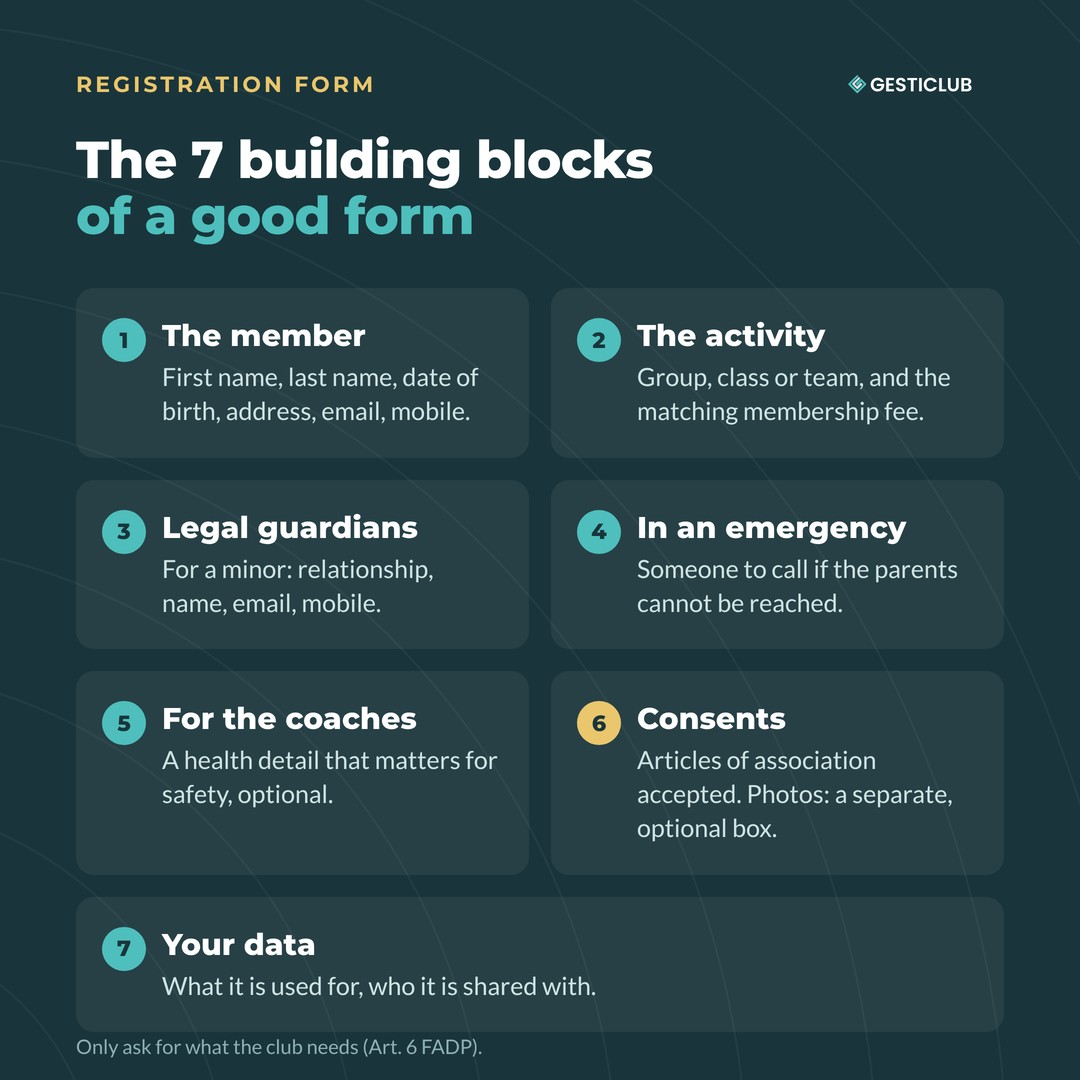
Identity: first name, last name, date of birth.
Contact details: address, email, mobile number.
For a minor: the legal guardian or guardians, with their relationship to the child, their email and their mobile number.
An emergency contact during activities.
The chosen activity: the group, class or team, and the matching membership fee.
Consents: the articles of association or rules accepted, and a separate consent for photos.
Information about the data: what it is used for, who it is shared with.
Anything else needs a case-by-case reason.
Why the registration form matters more than you think
The form feeds everything else. First the membership list. Then the membership fee invoice, which depends on age and group. The notices for the general meeting, sent to the address given. Course announcements to J+S (Youth and Sport). And on the day you need to call the parents, the form is what you open.
A piece of information missing at registration means chasing later, often more than once. A piece of information too many means data the club becomes responsible for without needing it. A good form is short, but complete.
The essential fields of a registration form
FieldWhy the club needs itMake it mandatory?First and last nameIdentify the memberYesDate of birthAge category, fee, knowing whether the member is a minorYesPostal addressInvoices and notices, depending on your articles of associationDepending on your practiceEmail addressNotices, invoices, club newsYes, unless a parent provides oneMobile numberReach someone quickly, warn of a changeStrongly recommendedGroup, class or teamPut the member in the right placeYesMembership categoryApply the right fee, and voting rights if your articles distinguish active and passive membersYes, if your articles make the distinctionAcceptance of the articles or rulesThe member's commitment to the clubYes
Two practical tips. Link the choice of group to the fee: that choice sets the amount to invoice, so let the member make it. And make the email mandatory for at least one person per family: it is how notices and invoices will reach them.
Registering a minor: legal guardians and emergency contact
For a child or teenager, the form must first identify their legal guardians. This is not just a practical matter. Membership commits the member to paying a fee, and a minor with capacity of judgement can, as a rule, only take on such an obligation with the consent of their legal representative (Art. 19 of the Swiss Civil Code).
For each legal guardian, ask for:
their relationship to the child;
their first and last name;
their email and mobile number.
Leave room for a second guardian. In a separated family, the person who receives the information is not always the one who pays: ask who receives the club's emails and who receives the invoices.
The emergency contact. This is the person to call if the child gets hurt and the parents don't answer. J+S also asks for one on its personal data sheet for activities. A name and a number are enough.
Health. An allergy or a treatment can matter at training or at a camp. But health data is sensitive personal data under the law (Art. 5 let. c FADP). Only ask for it if it serves the safety of the activity, as an optional question, and limit access to the people who look after the child.
Photos and image rights: a separate consent
The club publishes photos: a tournament on the website, a team on social media. The safest approach is to ask the people concerned for consent before publishing. The Federal Data Protection and Information Commissioner (FDPIC) points this out in its guidance for associations: consent can justify publication, and it can be withdrawn at any time. The association must then remove the photos without delay.
Three simple rules:
A separate box. Photo consent is not bundled with accepting the articles of association.
An optional box. Membership must not depend on this consent: a member can join without agreeing to be published.
For a child, ask the legal guardian for consent. A teenager with capacity of judgement decides about their own image (Art. 19c of the Civil Code): ask them too.
Record the date of the consent. On the day someone withdraws it, you will know what was published before.
What data protection law forbids you to ask for "just in case"
Since 1 September 2023, the revised Federal Act on Data Protection (FADP, often called the new FADP) also applies to associations. Three principles matter for a registration form.
Ask only for what is necessary. The FDPIC sums it up: only the data actually needed to fulfil the association's purpose may be processed. This is the principle of proportionality (Art. 6 FADP). Occupation, marital status or a passport photo have no place in a club form, unless your federation requires them for a licence.
Say what the data is for. At the time of collection, the person must know who is responsible for their data, what it is used for and who it is shared with (Art. 19 FADP). A sentence in the form and a link to the club's privacy notice are enough. And for the FDPIC, a federation is a third party: you may only pass members' data on to it if your articles of association provide for it or if members have agreed. Say so in the form.
Don't keep everything forever. Data is destroyed or anonymised as soon as it is no longer needed (Art. 6 para. 4 FADP). A former member has no reason to stay on your list. Accounting records, on the other hand, are kept for ten years.
The AHV number. If your club reports J+S courses, it needs it: J+S requires it for participants. Otherwise, it has no place in your form. Either way, its use is regulated by law: follow the instructions of J+S and your federation, especially on how long to keep it.
Paper form, PDF or online registration?
The paper form has one advantage: everyone knows how to fill it in. The drawbacks come afterwards. Everything has to be retyped, and a misread email address is a notice that will never arrive. A fillable PDF doesn't change much: it still has to be retyped.
An online registration form solves these problems at source. Mandatory fields can't be left empty, members choose their own group, and the data goes straight into the membership list.
One tip, whatever the format: have a parent fill in your form on their phone before you open it to everyone. What they don't understand, others won't either.
The registration form template to copy
Here is an outline to adapt to your articles of association and your sport.
1. The member First name, last name, date of birth, address, email, mobile. AHV number, only if your club reports J+S courses.
2. The activity Group, class or team chosen. Membership category (active, junior, passive, according to your articles). Fee amount, shown with the choice.
3. Legal guardians (if the member is under 18) For each: relationship to the child, first name, last name, email, mobile. Who receives the club's emails? Who receives the invoices?
4. In an emergency Name and phone number of the person to call if the legal guardians can't be reached.
5. Useful information for the coaches (optional) "Is there any health information the coaches need to know for your child's safety?"
6. Consents ☐ I have read the club's articles of association and rules, and I accept them. (mandatory) ☐ I agree that photos in which I, or my child, appear may be published on the club's website and social media. I can withdraw this consent at any time. (optional)
7. Your data "Data controller: [club name, email address]. The data in this form is used to manage your membership, your fees and the club's activities. It is shared with [your federation, J+S, the insurer] when necessary, as provided for in our articles of association. More information: [link to the club's privacy notice]."
With GestiClub
In GestiClub, the online registration form follows this outline, and the rest of the work takes care of itself.
The flow. The form opens on computer and phone, with the club's logo. The person chooses their class, sees the fee and the places left, and a full class can no longer be chosen.
Minors. A date of birth under 18 opens the parents' cards: relationship to the child, name, email and mobile, with a second card for the other parent. The form also asks who receives the club's emails and who receives the invoices.
Consents. A box lets people give their consent to photo publication, with the date recorded on the member's record. The rules to accept are a PDF: the member's record keeps the date of acceptance and the exact version of the document.
The AHV number. For a Swiss club affiliated with J+S, the form asks for the AHV number. A club that doesn't report J+S courses removes it from its form.
Your own questions. Custom fields can be added in an "Additional information" section, for example for the emergency contact.
What follows. The registration creates the member's record directly, with their group and fee, without retyping. The people you choose are notified, and the fee, attached to the member's record, goes out with the next membership fee mailing.
Find out more on the Online registrations page.
If you'd like to prepare next season's registrations with GestiClub, the trial is free for 30 days: start my free trial.
Frequently asked questions about club registration forms
What information should a club registration form ask for? Identity (first name, last name, date of birth), contact details (address, email, mobile), the group or class chosen, acceptance of the articles of association, and for a minor their legal guardians and an emergency contact. Photo consent is asked for separately.
Can a minor join a club on their own? Membership commits the member to paying a fee. A minor with capacity of judgement can, as a rule, only take on such an obligation with the consent of their legal representative (Art. 19 of the Swiss Civil Code). The form must therefore identify that representative.
Do you need consent to publish members' photos? It is the safest route. Ask for consent before publishing. It can be withdrawn at any time, and the photos must then be removed. For a young child, consent comes from the legal guardian. A teenager with capacity of judgement gives their own.
Can you ask for the AHV number at registration? Yes, if your club reports J+S courses: J+S requires it for participants. Otherwise, don't ask for it. Its use is regulated by law: follow the instructions of J+S and your federation.
How long should you keep a former member's data? As long as it is needed, then it is deleted or anonymised (Art. 6 para. 4 FADP). Accounting records, such as membership fee invoices, are kept for ten years.
Sources
Federal Act on Data Protection (FADP), Art. 5, 6 and 19, on Fedlex
Swiss Civil Code, Art. 19 and 19c, on Fedlex
Federal Data Protection and Information Commissioner, Data protection in clubs and associations
 Swiss hosting