
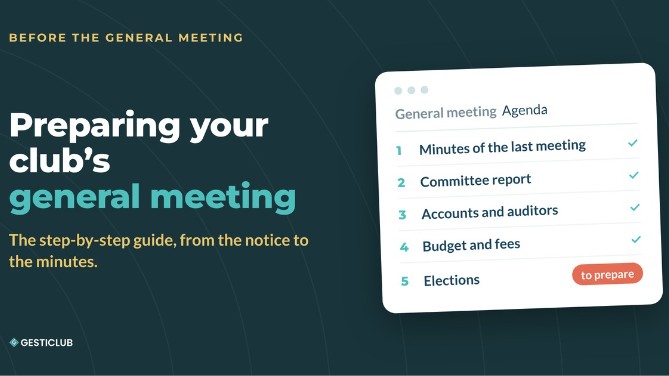
Preparing your club or association's general meeting in Switzerland: a step-by-step guide
The general meeting is one evening a year. And yet it decides almost everything: the accounts, the membership fees, the committee. Preparing a general meeting for your association is not complicated, as long as you do not leave everything to the final week.
Before I started publishing software, I was involved in running a club myself. Evenings that go off the rails often have the same cause: a question to the treasurer with no answer ready, or an item someone wants to vote on even though it is not on the agenda. This guide covers what the law says, what your articles of association decide, and a timeline that leaves time to do things properly.
What the law and your articles of association say
The Swiss Civil Code gives only a few articles to the general meeting. Some apply to every association, others only if your articles of association say nothing different (Art. 63):
The general meeting is the supreme governing body of the association. The committee convenes it, in the cases set out in the articles of association. If one fifth of the members ask for it, it must also be convened (Art. 64).
It admits and expels members, elects the committee and supervises it. It also deals with everything that is not the responsibility of another body (Art. 65).
A proposal approved in writing by all members counts as a decision of the general meeting (Art. 66).
Every member has an equal vote. Decisions are taken by a majority of the votes of the members present. And no decision is taken on an item that was not properly announced, unless the articles of association expressly allow it (Art. 67).
A member does not vote on a transaction or a dispute between the association and themselves, their spouse or a direct relative (Art. 68). This rule does not cover elections: a candidate may vote for themselves.
A member who did not agree to a decision can challenge it in court if it breaches the law or the articles of association, within one month of learning about it (Art. 75).
Convening at the request of one fifth of members, the Article 68 rule and the right to challenge a decision apply whatever your articles of association say. The other rules are defaults: your articles can, for example, let the committee admit members, reserve voting rights for active members or set a different majority.
Everything else is set by your articles of association: the notice period, its form (letter, email), any quorum, how votes are held, terms of office, the number of auditors. Before you start preparing, reread them. They are the document that counts, and that is often where the deadline everyone forgot is hiding.
The timeline, from two months before to one month after
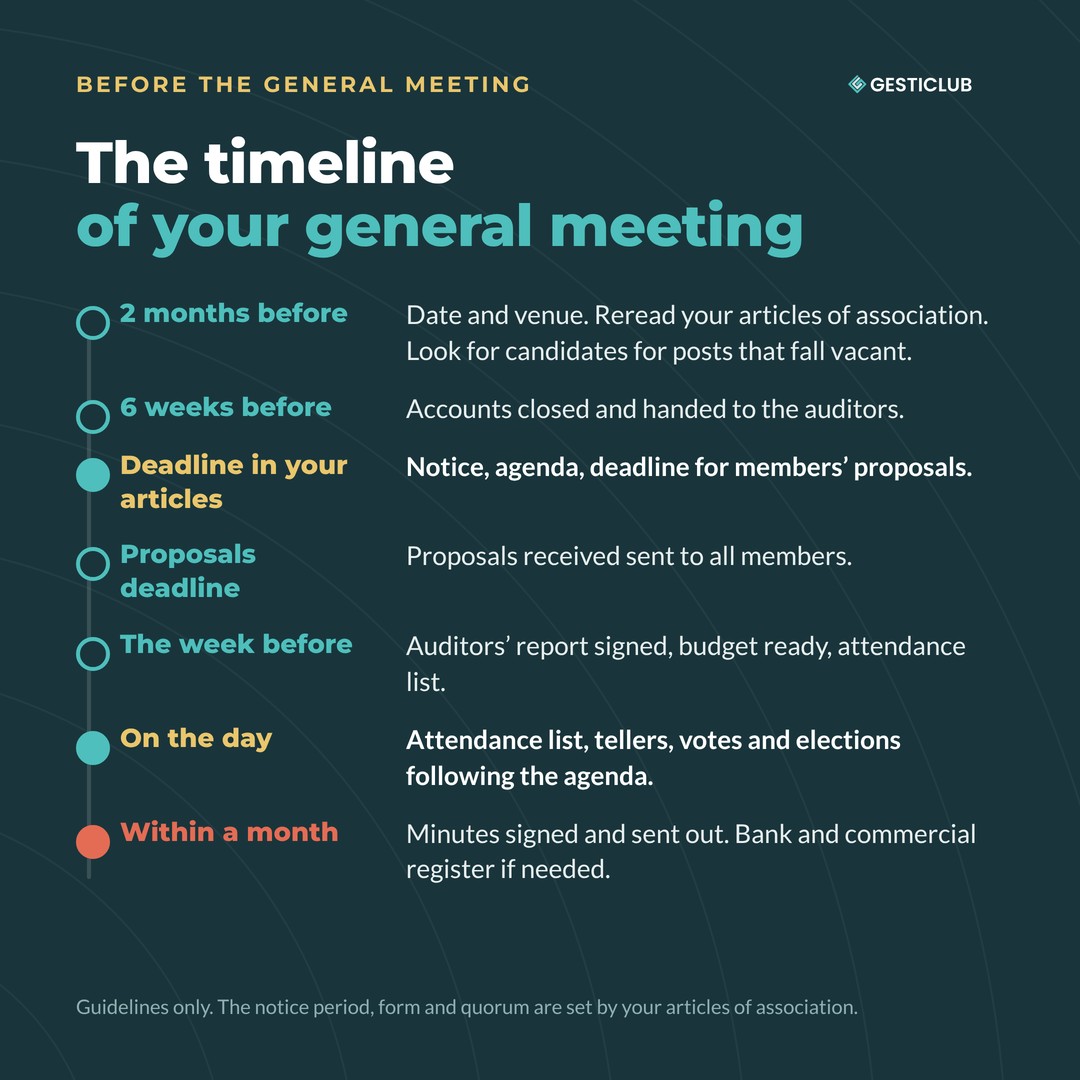
Here is the timeline I recommend. The deadlines in weeks are common-sense guidelines, not rules: the only deadline that really counts is the one in your articles of association.
Two months before. Set the date and book the venue. Reread the articles of association. Check whose term of office is ending, and start looking for candidates now: "who will take over as treasurer?" is the question that causes the longest silence of the evening.
Six weeks before. Close the year's accounts and hand them to the auditors. Giving them time is the best way to get a signed report before the evening.
Before the deadline in your articles. Send the notice with the agenda, and the deadline for members' proposals.
When the proposals deadline closes. Send all members the proposals received, so they appear clearly on the agenda.
The week before. Auditors' report signed, accounts and budget ready to present, attendance list printed or ready on screen.
On the day. Welcome people, have the attendance list signed, follow the agenda.
Within the following month. Write the minutes, have them signed, send them out and file them. Pass on any changes to the bank and, if your association is registered there, to the commercial register.
The notice and a model agenda
A good notice gives members everything they need to attend and vote: the date, time and place, the full agenda, the documents attached or where to consult them, and the deadline for submitting a proposal.
Here is a model agenda, to adapt to your articles of association:
Opening, attendance list and appointment of tellers
Approval of the agenda
Minutes of the last general meeting
Report of the president or the committee
Reports from coaches or sections
Annual accounts, auditors' report and discharge of the committee
Budget and membership fees for the coming season
Elections: committee and auditors
New members, resignations and expulsions
Members' proposals
Any other business
A word on "any other business". Since no decision is taken on an item that is not on the agenda (unless your articles of association allow it), any other business is for information and discussion, not for votes. If a member wants something put to a vote, they submit a proposal within the announced deadline, and the committee sends it to all members before the meeting. A proposal members only discover on the evening itself should not be voted on: the decision could be challenged.
Two points on item 9. For an expulsion, the notice must say which member is concerned, otherwise the decision can be challenged. Resignations, on the other hand, are not voted on: leaving the association is a member's right (Art. 70), and the meeting simply takes note.
The accounts, the treasurer's report and the auditors
This is the agenda item where the room wakes up. The treasurer gains a lot by preparing answers in advance to the five questions that come up almost every time.
"Why this loss?" Or this surplus. Find the items that changed most since last year, and prepare one sentence for each.
"Who hasn't paid?" The amount of membership fees still outstanding, and what has been done: reminders sent, arrangements agreed. The amount, not the names: the general meeting is not the place to name families.
"How much is left in the account?" The balance on the closing date, identical to the bank statement.
"Did the auditors see everything?" Receipts filed, and the auditors' report signed before the meeting.
"And next year?" A budget for the coming season, presented with the accounts: expected members, membership fees, grants. If the general meeting votes on the fees, the budget is what justifies them.
On auditors: the law requires an ordinary audit by a statutory auditor only for very large associations, those that exceed two of these thresholds in two consecutive financial years: a balance sheet total of CHF 10 million, turnover of CHF 20 million, an annual average of 50 full-time positions (Art. 69b). A limited audit can also be requested by a member who is personally liable for the association's debts, which is rare in a sports club. For all other clubs, the articles of association and the general meeting are free to decide how the accounts are checked. Most often, two auditors elected by the general meeting.
On the day: attendance list, votes, elections
The attendance list. It is not a formality: by default, decisions are taken by a majority of the members present, so you need to know who is there and who has a vote. If your articles of association set a quorum, the list is also what proves it.
The tellers. Appoint them at the start; they count the votes. In a close vote, their count is what goes into the minutes.
Voting. By show of hands or by secret ballot, according to your articles of association or a decision of the meeting. Remember Article 68: if the committee proposes giving the shirt printing to the treasurer's company, the treasurer does not vote. For the same reason, committee members do not vote on their own discharge. They do, however, vote normally in elections. And if your articles of association say nothing about abstentions, announce before the vote how you will count them.
Elections. Announce known candidates in the notice; it makes things calmer for everyone. And if a post stays vacant, say so clearly and record in the minutes how the committee will cover it in the meantime.
The minutes
The minutes are the club's memory. They must let someone who was not there know what was decided. Record at least:
the date, the place, the opening and closing times;
who chairs, who takes the minutes, how many members are present;
for each agenda item, the decision and the result of the vote;
the people elected and their terms of office;
the signatures required by your articles of association.
Write them quickly, while your notes are fresh. A member who did not agree to a decision has one month to challenge it from the moment they learn about it: clear minutes sent out promptly avoid many misunderstandings.
After the meeting
Send the minutes to members and file them with the articles of association.
Update signing rights at the bank if the committee has changed.
Report changes to the commercial register, if your association is registered there.
Organise the handover: access to the accounts, documents and passwords.
Update the membership list (new members, resignations) and apply the fees voted for the next invoicing round.
With GestiClub
In GestiClub, several steps on this list happen in one place.
The notice. Sending a newsletter to the club does not require keeping a separate address list: it comes straight from the groups and families in the Contacts module.
The documents. Articles of association and general meeting minutes stay hosted in Switzerland, backed up every day, with a recycle bin in case of a mistake.
The accounts. Account statements, results and budgets are prepared directly for the auditors' report and the general meeting. And the income statement of a closed financial year stays available.
You will find the details in the accounting guide.
If you would like to prepare your next general meeting with GestiClub, the trial is free for 30 days: start my free trial.
Frequently asked questions about an association's general meeting
Who convenes the general meeting of an association? The committee, in the cases set out in the articles of association. If one fifth of the members ask for it, the meeting must also be convened (Art. 64 of the Civil Code).
What notice period applies to a general meeting? The Civil Code sets none: the notice period in your articles of association applies, in the form they set out. If they are silent, allow a reasonable period that gives members time to prepare; two weeks is a safe choice.
Can you vote on an item that is not on the agenda? No, unless the articles of association expressly allow it (Art. 67). Any other business is for information and discussion.
Does the general meeting need a quorum? The law does not require one. By default, decisions are taken by a majority of the votes of the members present, unless your articles of association set a different majority or a quorum.
How long do you have to challenge a decision of the general meeting? One month from the day the member learned about it, if the decision breaches the law or the articles of association and the member did not agree to it (Art. 75).
Sources
Swiss Civil Code, Articles 63 to 70 and 75, on Fedlex, the official publication of federal law (the English version is for information and has no legal force)

 Swiss hosting