
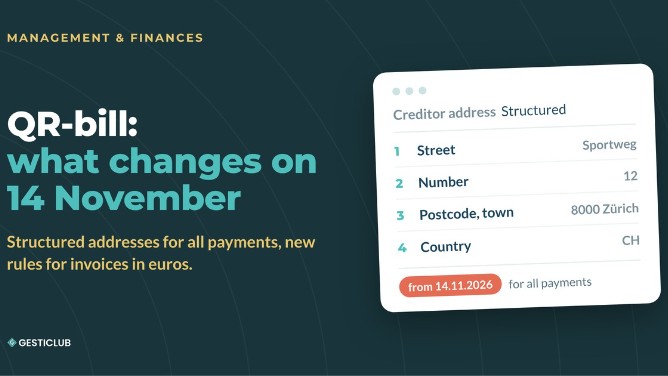
On 14 November 2026, the Swiss financial centre takes the last step towards structured addresses: they become mandatory for all payments, not just for QR-bills. A payment whose address does not follow the rule will no longer be processed. For a club, the November 2026 QR-bill changes affect three things: the membership fee invoices you send, the payments you make to suppliers and your members' standing orders.
The rules come from SIX, which runs Switzerland's payment infrastructure and writes the QR-bill guidelines. I have read them for you, with links to every document at the end of the article. You have two weeks left: enough to check everything, as long as you start now.
What changes on 14 November 2026
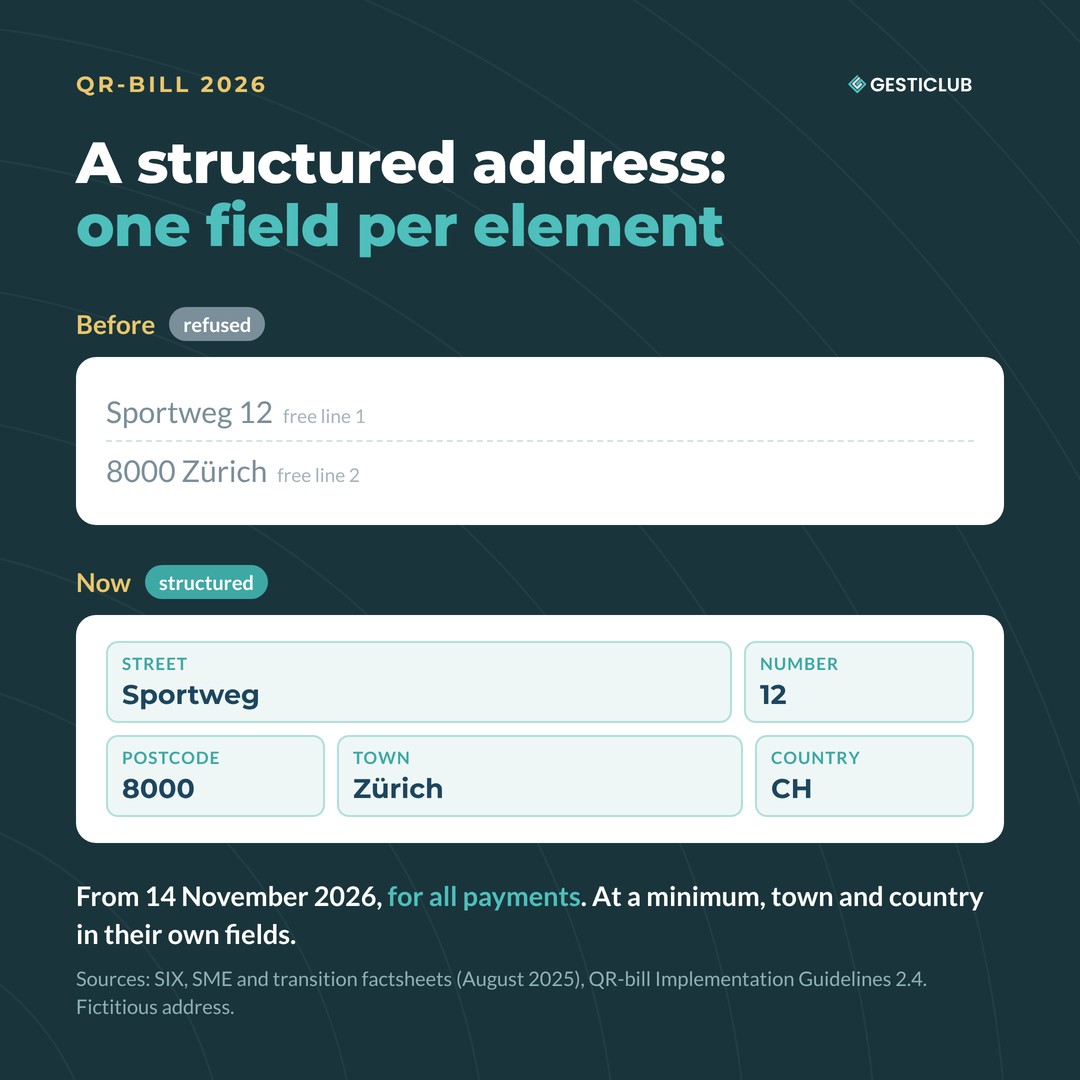
Structured addresses become mandatory for all payment orders. The addresses of every party involved in a payment must follow the new rule. At a minimum, the town and the country, each in its own field.
Payments that do not comply are no longer processed. A payment with an unstructured address must have an execution date before 14 November 2026.
Only one version of bank files. Also from 14 November, only the 2019 version of the ISO 20022 formats is supported: pain.001.001.09 for payment orders, camt.05x.001.08 for bank statements. That is your software's job, not yours, but it has to keep up (more on this below).
Every bank must make sure that existing standing orders and templates are adjusted by 13 November 2026 at the latest, either automatically or by asking the customer to act. Follow your bank's instructions. SIX also recommends no longer using old saved templates, for example in e-banking.
At PostFinance, structured addresses only. PostFinance does not accept hybrid addresses. Other banks are free to accept them or not: two free lines at most, with the town and country in their own fields.
One exception: LSV+ and BDD direct debits keep unstructured addresses until these schemes end, at the end of September 2028.
A reminder: structured addresses since November 2025
The QR-bill got there first. Since 22 November 2025 (guidelines version 2.3), a QR-bill contains only structured addresses, known as type S. The old unstructured address, type K, is only tolerated for a short transitional period, for which SIX gives no end date.
A structured address is simple: each part has its own field. Street, building number, postal code, town and country, separately, instead of two lines of free text. Postal code, town and country are essential; street and building number are optional, but better filled in.
Good news along the way: all characters allowed in the federal register of persons are now accepted. Using them is up to each issuer: if your software supports them, a member's name can be written exactly as in the register.
What the club checks
The club's address on its invoices. With version 2.4 of the guidelines, valid from 14 November 2026, the creditor's postal code, town and country must always be given, each in its own field. Street and building number remain optional, and the building number may still sit in the street field for now.
The invoicing software. SIX asks SMEs to make sure with their supplier, before November 2026, that the software has the address data it needs and supports the 2019 version. If your club prepares invoices with a spreadsheet and a QR generator, check the tool's version.
Members' addresses. A structured address needs clean data: postal code and town in their own fields, and ideally street and building number separated. A list where the whole address sits on one line needs reworking before the next invoicing round.
The club's own payments. Hall rental, the federation, suppliers: rebuild the templates in your e-banking with structured addresses rather than relying on the old ones.
Invoices in euros, if your club issues any (see below).
Importing bank statements. If your treasurer imports the bank's statements into software, ask whether it reads the 2019 version, camt.05x.001.08.
What your members need to know
Membership fees paid by standing order. Every bank must make sure its customers' standing orders are adjusted by 13 November 2026 at the latest, either automatically or by asking them to act. And if the club sends a new QR-bill with a structured address, the standing order must use these new details. The simplest thing: tell the members concerned.
Old invoices. An invoice printed with the old unstructured address (type K) may already be refused, and will no longer go through after 14 November. If a member pays an old invoice late, send them a fresh copy instead.
Here are three sentences you can copy as they are into your next newsletter:
From 14 November 2026, Swiss banks no longer process payments whose address is not structured. If you pay your membership fee by standing order, use the details from the club's latest invoice and follow your bank's instructions. And if you still have an old invoice to settle, ask us for a new copy.
Invoices in euros
Few clubs are affected, but for those that invoice some members or partners in euros, version 2.4 of the guidelines, valid from 14 November 2026, changes things:
the QR-IBAN and the QR reference are reserved for invoices in Swiss francs;
in euros, only two combinations remain possible: IBAN with a SCOR reference (the international Creditor Reference), or IBAN with an unstructured message.
Version 2.3 remains valid until November 2027. If you invoice in euros with a QR-IBAN, plan the switch now and check the date with your bank.
With GestiClub
[VERSION A, if Franco confirms the three points]
In GestiClub, membership fees go out as Swiss QR-bills, with structured addresses for the club and for each member. Addresses come from each member's record and are corrected in one place. And importing your bank statement in the 2019 format matches payments to invoices without retyping.
You will find the details in the invoicing guide.
If you would like to see it with your own club, the trial is free for 30 days: start my free trial.
Frequently asked questions about the QR-bill in November 2026
What changes for the QR-bill in November 2026? From 14 November 2026, structured addresses become mandatory for all payments, and version 2.4 of the guidelines reserves the QR-IBAN and QR reference for invoices in Swiss francs. The creditor's address must include postal code, town and country. On the same day, banks support only the 2019 version of payment files.
Is a structured address mandatory for an association? Yes. The rule applies to all payments, whoever issues the invoice, except LSV+ and BDD direct debits until the end of September 2028. A QR-bill has in any case contained only structured addresses since 22 November 2025.
Will my standing order for the membership fee still work after 14 November 2026? Every bank must make sure standing orders and templates are adjusted by 13 November 2026 at the latest, either automatically or by asking you to act: follow its instructions. If the club sends a new QR-bill, copy its details into your standing order.
Can you still issue a QR-bill in euros? Yes. With version 2.4 of the guidelines, valid from 14 November 2026, the QR-IBAN and QR reference are reserved for Swiss francs: in euros, only IBAN with a SCOR reference or IBAN with an unstructured message remain possible. Version 2.3 remains valid until November 2027.
What is a structured address? An address in which each part has its own field: street, building number, postal code, town and country. Postal code, town and country are essential. It replaces the address written on two free lines.
Sources
SIX, August 2025: factsheet for SMEs on addresses and message version (PDF)
SIX, August 2025: QR-bill, transition period 2025-2026 (PDF)
SIX: QR-bill Implementation Guidelines, version 2.4, valid from 14 November 2026 (PDF)
PostFinance: address adjustments
 Swiss hosting