

For many clubs, the financial year ends on 31 December. For the treasurer, that is when another job begins: closing the accounts, handing them to the auditors, then presenting them at the general meeting.
None of this is difficult. What costs you is discovering everything in February: a membership fee that was never paid, a bank statement nobody can find, a December invoice that arrives in January. Here is the checklist I would follow, in order, with what the law really asks of an association.
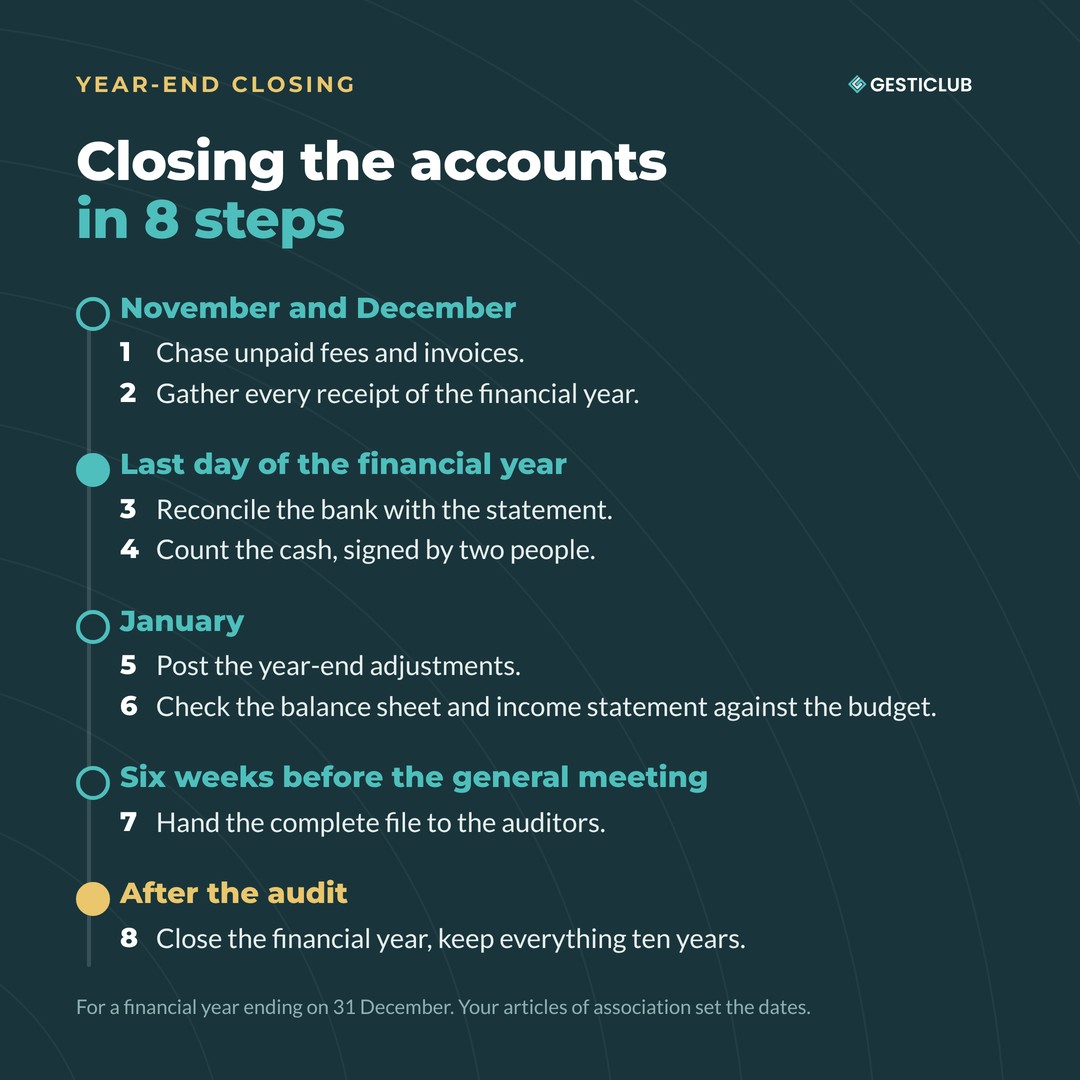
In short: closing the accounts in eight steps
Chase membership fees and invoices that are still unpaid.
Gather every receipt of the financial year.
Reconcile each bank account with its statement on the last day of the financial year.
Count the cash and have two people sign.
Post the year-end adjustments (expenses and income that straddle two years).
Check the balance sheet and income statement, and compare them with the budget.
Hand the complete file to the auditors.
Close the financial year once the accounts are audited, and archive.
What the law asks of an association's treasurer
The Civil Code is brief on the subject. The committee keeps the association's books, and the Code of Obligations' rules on accounting apply by analogy (Art. 69a CC).
Simplified accounting is often enough. An association that is not required to register in the commercial register only needs to keep accounts of income and expenditure and of its assets (Art. 957 para. 2 CO). That is the case for most sports clubs. A club that runs a commercial business, or whose accounts must be audited, must register, however (Art. 61 para. 2 CC). You can do more, with double-entry bookkeeping, but the law does not require it.
Your articles of association set the rest: when the financial year ends (often 31 December or 30 June), how many auditors you have, and the deadline for presenting the accounts to the general meeting.
Records are kept for ten years. The books and accounting records must be kept for ten years from the end of the financial year (Art. 958f CO).
What about tax? Members' contributions are not part of the association's taxable profit (Art. 66 DFTA). For direct federal tax, small profits are not taxed: below 5,000 francs (Art. 71 para. 2 DFTA), and up to 20,000 francs for an association with a non-profit (ideal) purpose that allocates them exclusively and irrevocably to that purpose (Art. 66a DFTA). For cantonal and communal taxes, the rules and thresholds depend on the canton. The association's tax return is prepared from the accounts you are closing, and if in doubt, your cantonal tax office can answer.
Before the year ends: collect what you can
The best time to reduce unpaid fees is before closing, not at the general meeting.
Chase unpaid fees in November and December. A friendly reminder is often enough: many unpaid fees are simply forgotten.
Invoice whatever is still due: a sponsor, a hall rental, a camp.
Ask coaches and volunteers for receipts for expenses they paid out of pocket. A reimbursement settled in December is one less entry to carry over.
Review with the committee the old fees that will never be recovered. Writing them off is a committee decision: record it in the minutes.
At the meeting, someone will ask "who hasn't paid?". Prepare the amount and what was done about it, not the names.
Reconcile the bank and the cash
The bank. For each account, on the last day of the financial year, the balance in your books must match the bank statement exactly. If there is a difference, find it now: a payment entered twice, forgotten bank charges, a member's payment allocated to the wrong person. Don't forget secondary accounts: savings, a section's account, a camp account.
The cash. If your club runs a snack bar or event till, count the cash on the last day of the financial year. Write the amount on a dated sheet signed by two people. The cash balance in the books must match.
Year-end adjustments
If your club keeps double-entry books, some amounts concern two financial years. Year-end adjustments put them in the right year. These are prepaid expenses and accrued income on the assets side, accrued expenses and deferred income on the liabilities side. Four club examples:
SituationWhat it isWhyMembers pay next year's fee in DecemberIncome received in advance (deferred income, liability)The income belongs to the next financial yearDecember's hall invoice arrives in JanuaryExpense still to be paid (accrued expense, liability)The expense belongs to the year being closedNext year's insurance is paid in DecemberExpense paid in advance (prepaid expense, asset)The expense belongs to the next financial yearA grant has been awarded but will be paid next yearIncome still to be received (accrued income, asset)The income belongs to the year being closed
Do you keep cash-basis accounts, income and expenditure only? Then these adjustments don't apply. Simply note the amounts in an appendix to the accounts, so the general meeting gets an accurate picture.
Check before you present
Before handing anything over, read the accounts the way a member will.
Does the balance sheet balance? In double entry, total assets equal total liabilities.
Are the accounts complete? Every receipt is entered, and every entry has its receipt.
What has changed? Compare each line with the budget and with last year. Prepare a one-sentence explanation for every big difference.
Is next season's budget ready? The general meeting often votes on the budget and the fees together with the accounts.
The file for the auditors
Your auditors should be able to check everything without calling you ten times. Give them a complete file, early enough: I recommend six weeks before the general meeting.
the balance sheet and income statement;
the journal or general ledger for the financial year;
the bank statements on the last day of the financial year;
the signed cash sheet;
the list of fees and invoices still unpaid;
the receipts, filed in the order of the entries;
the budget compared with actual figures.
For what comes next, from the notice to the minutes, see our guide to preparing your club's general meeting.
Close the financial year and open the next
In accounting software, closing a financial year usually locks it: nothing can be changed afterwards. My advice: only lock it once the accounts have been audited, ideally once the general meeting has approved them. If an auditor finds a mistake, you can still correct it.
In the meantime, nothing stops you from starting the new year. Open the new financial year, carry over the balance sheet balances, and post January's entries in the right year.
Once the year is closed, archive the complete file: accounts, auditors' report, and the minutes of the general meeting that approved them. That is the file you will be asked for in ten years, or that your successor will look for next year.
With GestiClub
In GestiClub, a good part of this checklist happens in one place.
Unpaid fees. Invoices stay in the list of open invoices as long as a balance is due. A button sends reminders for overdue invoices, and open invoices are grouped by the last reminder received, up to the formal notice.
The bank. Importing the bank statement settles the invoices that have been paid. One click on the posting button transfers invoices and payments to the accounts, without retyping.
Receipts. You attach your receipts directly to the entry, up to five per entry.
Auditors and the general meeting. Account extracts, results and budgets can be prepared directly for the auditors' report and the general meeting.
The new financial year. You can create it before closing the previous one, and post entries in both during that time. The chart of accounts is copied, and the balance sheet balances and the result are carried forward.
Closing. A checklist verifies, among other things, that the balance sheet balances before closing. The closed year then remains available, read-only. It cannot be reopened: that is why it is better to close after the audit.
Find out more on the Accounting page.
If you'd like to start your next financial year with GestiClub, the trial is free for 30 days: start my free trial.
Frequently asked questions about closing an association's accounts
When should an association close its accounts? At the end of the financial year set by your articles of association, often 31 December or 30 June. Closing must be finished early enough for the auditors to check the accounts before the general meeting.
Does a small association need double-entry bookkeeping? No, if it is not required to register in the commercial register. It can keep accounts of income and expenditure and of its assets (Art. 957 para. 2 CO).
How long must an association keep its accounting records? Ten years from the end of the financial year, for the books and accounting records (Art. 958f CO, applicable by analogy to associations under Art. 69a CC).
Who audits a club's accounts? Usually two auditors elected by the general meeting, as set out in the articles of association. The law requires an audit firm for very large associations, or when a member who is personally liable for debts or obliged to make additional contributions demands it (Art. 69b CC). Otherwise, your articles of association decide.
Are membership fees taxable? No. Contributions paid by members are not part of the association's taxable profit (Art. 66 DFTA). For anything else, ask your cantonal tax office.

 Swiss hosting